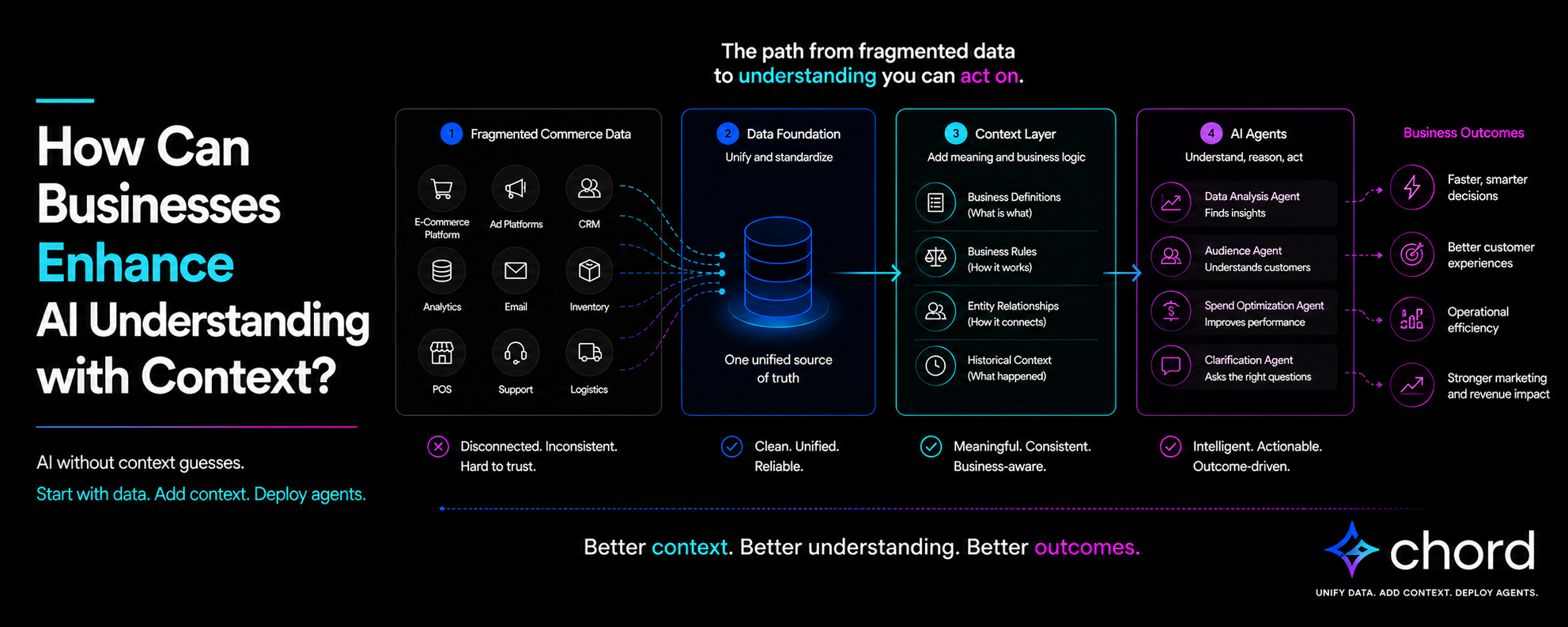
How Can Businesses Enhance AI Understanding with Context?
A governed context layer between AI models and databases structures metadata and business logic, preventing frequent errors.
By [email protected] · June 30, 2026
TL;DR
• Businesses enhance AI understanding by implementing a governed context layer between large language models (LLMs) and enterprise databases.
• This layer structures metadata, captures tribal business logic, and translates dynamic operational rules in realtime.
• It ensures AI agent actions are grounded, accurate, and completely aligned with business policies.
• By decoupling business logic from the underlying model, companies prevent common errors and hallucinations found in generic prompt systems.
• This approach allows enterprise teams to safely deploy autonomous workflows within complex transactional environments.
Table of Contents
• What are the Core Mechanics of AI Contextual Grounding?
• How Do Regulatory Standards Impact AI Context Management?
• When is a Business Suitable for a Fully Governed Context Layer?
• What are RealWorld Examples of ContextGrounded AI in Action?
• What are the Enterprise Costs of Building vs. Buying an AI Context Layer?
• What is the StepbyStep Strategy to Implement Enterprise AI Context?
What are the Core Mechanics of AI Contextual Grounding?
The mechanics of AI contextual grounding involve a multistep pipeline that intercepts user queries, evaluates realtime business logic rules, retrieves relevant context from databases, and injects clean semantic metadata alongside the prompt. This process ensures the large language model receives unambiguous parameters and strict operational boundaries before generating any output.
To achieve this, the grounding pipeline executes three primary operational phases:
• Semantic Mapping: Translating ambiguous business terminology into standardized definitions before retrieval occurs.
• Metadata Injection: Attaching temporary variablessuch as user location, transaction history, or current catalog pricingdirectly to the runtime container.
• Logical Guardrails: Restricting the model's outputs to specific datasets, ensuring it refuses queries outside its defined authority.
Note: For a deepdive comparison on why basic textretrieval systems fall short in retail settings, read our comprehensive analysis on Why Standard RAG Fails Enterprise ECommerce: RAG vs. Context Layer.