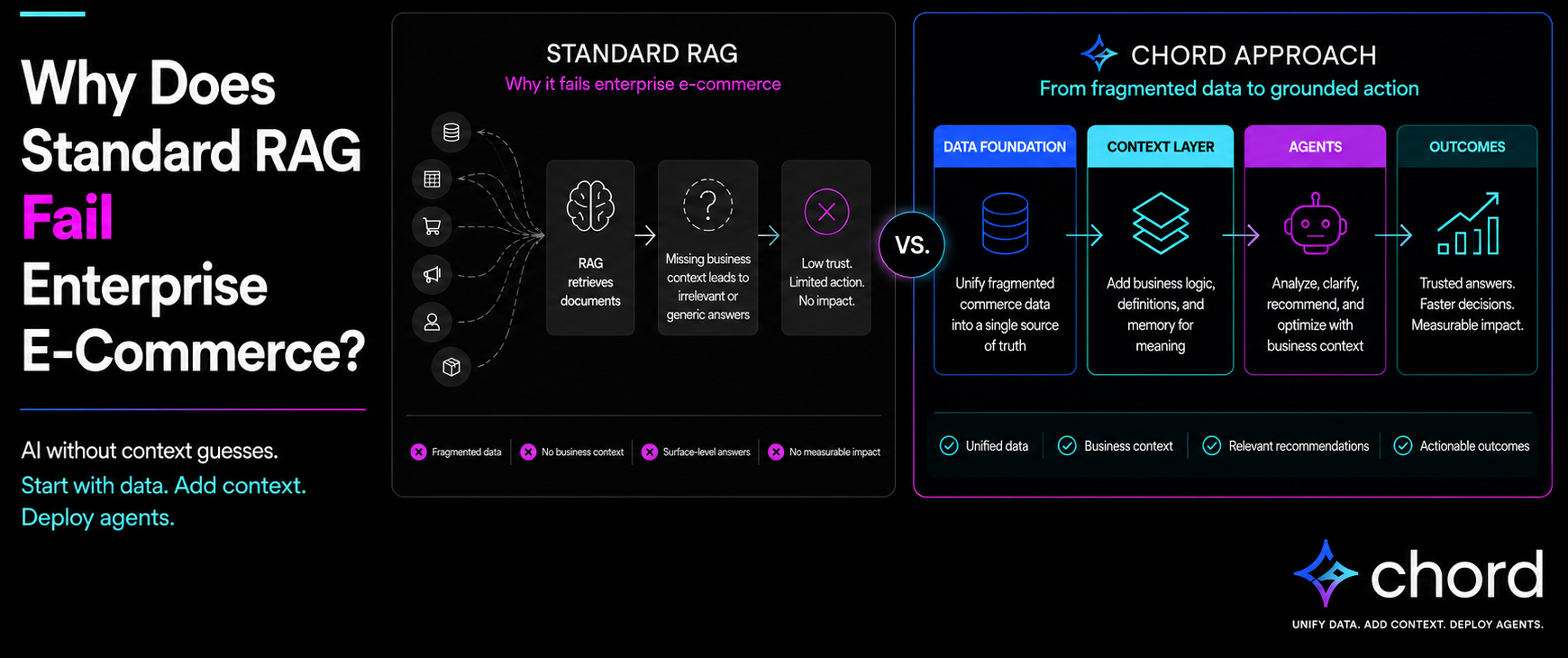
Why Does Standard RAG Fail Enterprise E-Commerce?
Standard RAG struggles with realtime margins and dynamic rules in enterprise ecommerce.
By [email protected] · June 30, 2026
TL;DR
• Standard RAG struggles in enterprise ecommerce because it cannot handle dynamic business rules, realtime margins, or complex attribution logic.
• It primarily retrieves static text, leading to failures in highstakes retail environments.
• Operational retail AI requires a structured context layer to codify institutional knowledge and govern transactionlevel decisions accurately.
• A context layer ensures accurate data by applying complex, fluctuating operational rules to realtime transactional streams.
• Without a context layer, generic AI implementations in retail can lead to expensive failures and financially damaging errors.
Table of Contents
• What is the Difference Between RAG and a Context Layer?
• How Do Retrieval Limitations Lead to ECommerce AI Hallucinations?
• What are the Operational Tradeoffs of Implementing a Context Layer?
• Frequently Asked Questions
What is the Difference Between RAG and a Context Layer?
The primary difference between standard RAG and a context layer is how business logic is structured and applied. Standard RAG retrieves unstructured text chunks matching a vector search query, treating all document snippets with equal priority. A context layer, conversely, is a governed semantic infrastructure that integrates operational logic, realtime variables, and tribal knowledge, translating raw database inputs into accurate, policyaligned business actions.
While RAG works well for simple document search, enterprise retail demands complex relational mapping. The following table contrasts the two approaches across key ecommerce capabilities:
| Feature | Standard RAG Architecture | Enterprise Context Layer | | : | : | : | | Data Format | Unstructured text snippets, PDF manuals | Structured business logic, database views, rules | | Logic Handling | Relies on LLM reasoning to interpret policies | Enforces strict rule boundaries before LLM execution | | RealTime Accuracy | High latency; limited to static document updates | Realtime synchronization with active warehouse systems | | Financial Calculations | High risk of calculating incorrect margin metrics | Precise math execution grounded in semantic models |
How Do Retrieval Limitations Lead to ECommerce AI Hallucinations?
Retrieval limitations cause retail AI hallucinations because standard search systems cannot resolve conflicting or temporal business rules. When an AI agent relies on basic keyword or vector matching, it easily mixes outdated promotions with current pricing, or confuses booking metrics with net revenue. Without explicit business logic boundaries, the model generates confident but financially damaging errors.
To understand why this happens, consider how a standard RAG system processes an inventory and refund query:
• Semantic Search Trigger: A customer queries an AI agent about a refund for a damaged item.
• Passage Retrieval: The vector database retrieves the general "Returns Policy PDF" but misses the active "Winter 2026 Promotional Adjustments" database rule.
• Context Assembly: The system injects conflicting text passages into the prompt pipeline.
• Erroneous Generation: The LLM fills the knowledge gap by hallucinating a $150 credit payout that violates active company margin targets.
What are the Operational Tradeoffs of Implementing a Context Layer?
Implementing a comprehensive context layer requires an upfront investment in codifying tribal knowledge and establishing rigorous data governance. While basic RAG can be deployed in a weekend using opensource templates, a true enterprise context layer demands active collaboration between data engineers and business operators to define exact margin metrics, rule hierarchies, and evaluation pipelines.