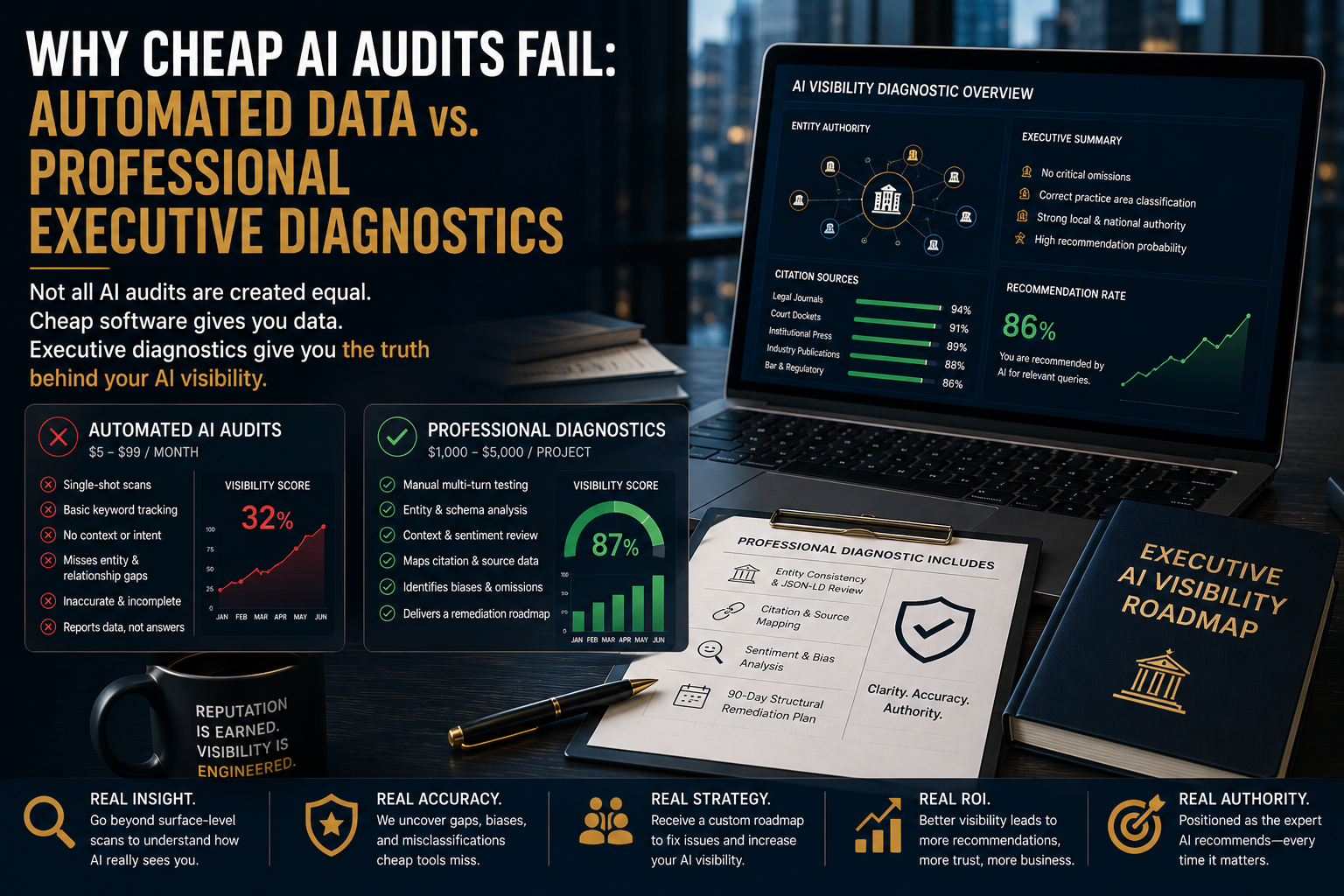
Why Cheap AI Audits Fail: Automated Data vs. Professional Executive Diagnostics
Automated AI audits cost $5$99 monthly, yet only scrape static keywords. Learn why professional executive diagnostics are vital for protecting your.
By William McNeil · July 4, 2026
Why Cheap AI Audits Fail: Automated Data vs. Professional Executive Diagnostics
What is the difference between automated and professional AI audits?
An automated AI audit uses basic software scripts to scrape static keyword mentions across language models, costing between $5 and $99 monthly. A professional executive diagnostic, ranging from $1,000 to $5,000, is a manual, highsecurity investigation that maps complex entity relationships, identifies recommendation biases, and corrects LLM misclassifications through noninvasive prompt testing and source mapping.
For established attorneys, commercial bankers, and healthcare executives, digital representation is a matter of professional survival. When an AI search engine like ChatGPT, Claude, or Gemini recommends a competitor or misidentifies your core area of expertise, it directly impacts your firm's revenue.
While automated software platforms promise quick, lowcost visibility reports, they lack the analytical depth required to protect highstakes professional reputations. Understanding the structural limitations of cheap, automated data is the first step toward correcting critical visibility errors.
TL;DR
• Cheap automated AI audits ($5$99/month) rely on static keyword scraping and lack the analytical depth needed for professional reputations.
• Professional executive diagnostics ($1,000$5,000) involve manual, highsecurity investigations to map complex entity relationships and correct LLM misclassifications.
• Automated tools fail to capture the dynamic, conversational nature of LLMs due to rigid queries, context blindness, and security blocks.
• Professional diagnostics evaluate foundational digital entities, schema architectures, and authoritative citation sources through multiturn prompt testing.
• Hightrust professional service firms require professional diagnostics to identify and correct reputationAI reality gaps, which automated software cannot.
Table of Contents
• What is the difference between automated and professional AI audits?
• Why does automated AI tracking fail to capture true executive search visibility?
• What structural components are included in a professional executive diagnostic?
• How do you determine if your business requires a professional diagnostic over automated software?
• Frequently Asked Questions
Why does automated AI tracking fail to capture true executive search visibility?
Automated AI tracking software relies on static API calls and simple keyword matching, which fail to capture the dynamic, conversational nature of Large Language Models (LLMs). Because LLMs generate answers probabilistically based on semantic context rather than fixed index rankings, a simple automated scan cannot replicate the multiturn conversational prompts that real prospects use when looking for highvalue professional services.
Loading diagram...
The Technical Limitations of Automated Reports
• Query Rigidity: Automated scrapers run rigid, singlesentence prompts that do not reflect natural humantoAI search behavior.
• Context Blindness: Softwarebased checks report whether your brand name appeared, but they cannot evaluate the sentiment, surrounding context, or the accuracy of the professional expertise being attributed to you.
• Crawl Block Obstacles: Many automated trackers are blocked by standard web security protocols, leading to incomplete or inaccurate data collection.