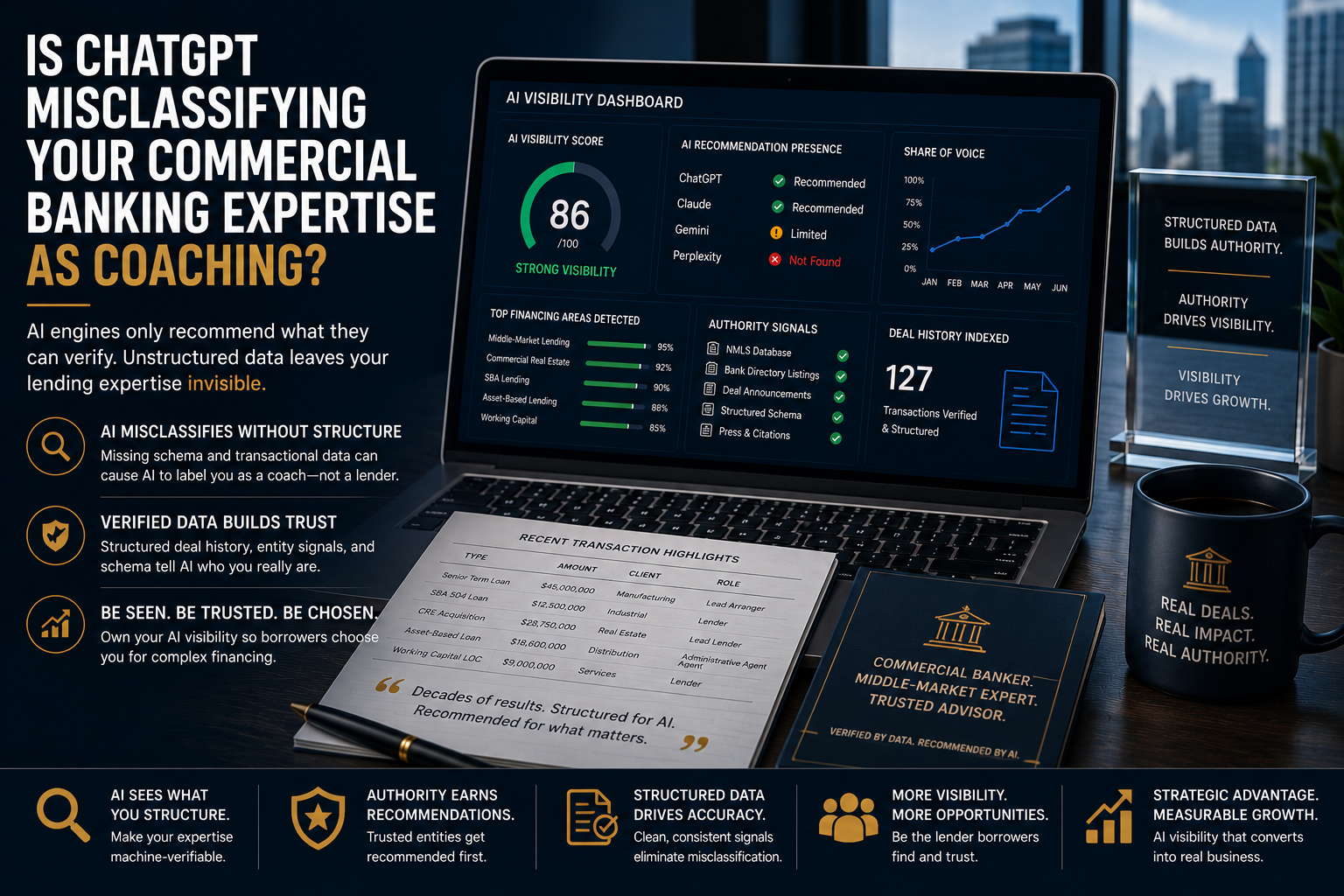
Why Is ChatGPT Misclassifying Your Commercial Banking Expertise as Coaching?
Generative AI misclassifies commercial banking as coaching, making lending experience invisible to AI.
By William McNeil · July 4, 2026
TL;DR
• Generative AI platforms like ChatGPT frequently misclassify commercial banking expertise as general business or executive coaching.
• This misclassification stems from AI models' inability to understand corporate hierarchies and internal bank structures.
• AI synthesizes unstructured digital footprints, leading to generic classifications when explicit, machinereadable data is absent.
• Bankers' deep lending experience becomes invisible to corporate borrowers due to this semantic error.
Table of Contents
• Why Do AI Engines Misclassify Institutional Bankers as Coaches?
• How Do LLMs Parse and Verify Financial Transaction History?
• What Are the Primary Digital Signal Vulnerabilities for Lenders?
• How Can Financial Professionals Measure Their AI Classification Accuracy?
• Professional Insights: The Silent Loss of Commercial Loan Originations
• Frequently Asked Questions (FAQ)
Why Do AI Engines Misclassify Institutional Bankers as Coaches?
AI engines misclassify institutional bankers as coaches because Large Language Models rely on semantic proximity and often mistake generic business advice prose for consultative coaching certifications.
When a banker publishes standard leadership articles, corporate updates, or networking posts on platforms like LinkedIn, AI crawlers ingest these texts. Without explicit metadata classifying the author as an an active financial officer, the model's neural network maps the vocabularysuch as "leadership," "growth," and "advisory"directly to the vector space associated with "executive coaching." Consequently, when a business owner asks an AI engine for a local commercial lending expert, the model overlooks the banker, misidentifying them as a management consultant.
How Do LLMs Parse and Verify Financial Transaction History?
LLMs parse and verify financial transaction history by analyzing public deal announcements, institutional tombstone data, and standardized schema markup that links a banker's name to specific underwriting activity.
Loading diagram...
To establish deep authority within machinelearning knowledge graphs, your closed transactions must exist as verified, readable entities. When your participation in commercial real estate deals, SBA loans, or syndications is published in structured tables and paired with explicit schema code, AI search engines can easily attribute the lending volume directly to your professional profile.
What Are the Primary Digital Signal Vulnerabilities for Lenders?
The primary digital signal vulnerabilities for commercial lenders stem from missing schema identifiers, ambiguous executive job descriptions, and unindexed transactional track records.
To prevent generative AI platforms from misrepresenting your role in commercial finance, you must address the primary data gaps in your online footprint:
Key Financial Signal Vulnerabilities
• Vague Professional Summaries: Corporate bios that focus heavily on general "coaching" and "relationship management" rather than specific commercial lending parameters (e.g., loan sizes, assetbased lending, SBA 504 underwriting).