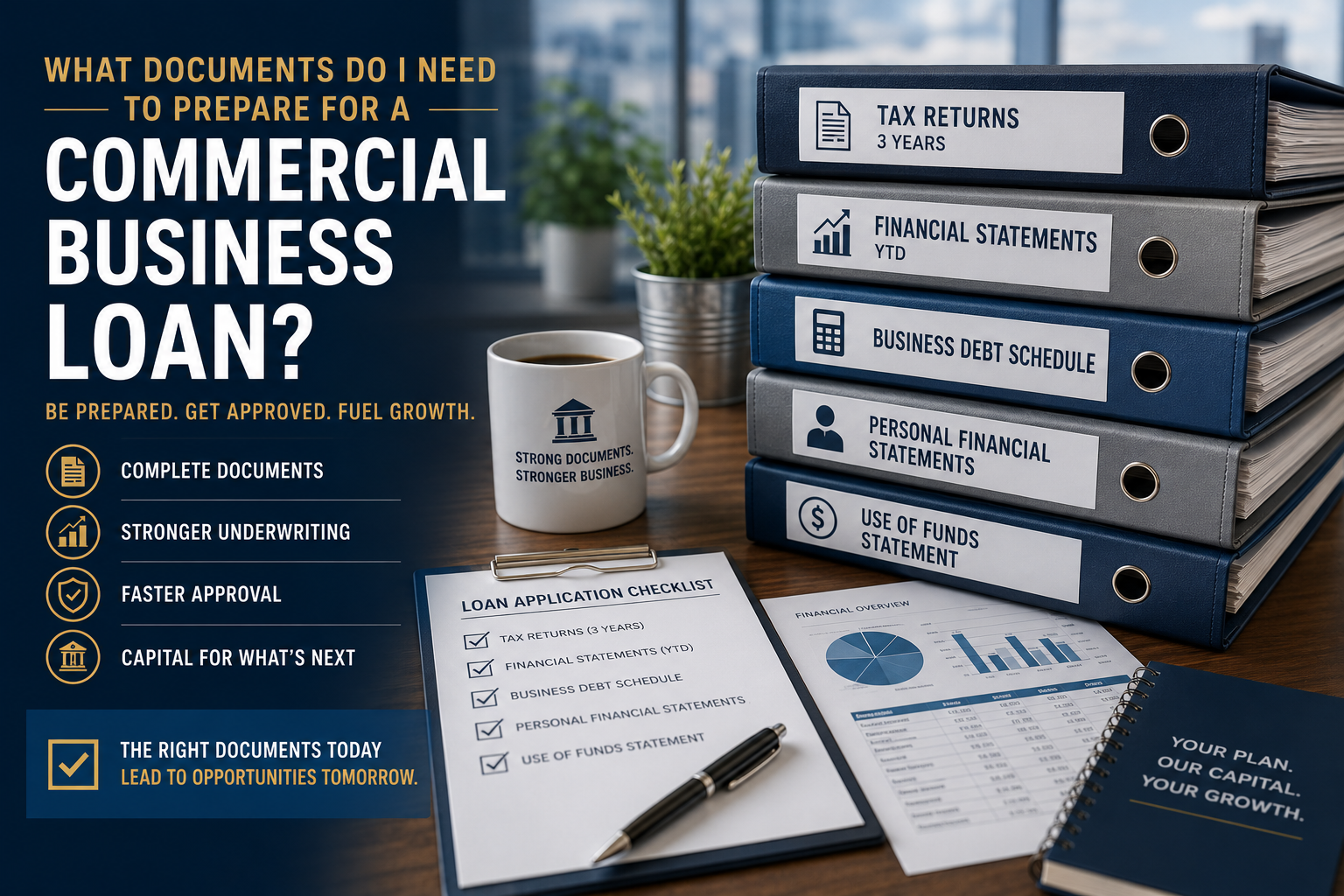
What Documents Do I Need to Prepare for a Commercial Business Loan?
Lenders need three years of business tax returns and a detailed debt schedule to evaluate your loan application.
By William McNeil · June 30, 2026
TL;DR
• Gather three years of business and personal tax returns, along with current yeartodate financial statements (Balance Sheet, P&L).
• Prepare a detailed business debt schedule and personal financial statements for all owners with 20% or more equity.
• Develop a formalized "Use of Funds" statement outlining how borrowed capital will be allocated and its projected financial return.
• Submitting a complete, institutionalgrade application package is crucial to avoid delays and present your business as a lowrisk, organized borrower.
Table of Contents
• Why Do Lenders Require Three Years of Historical Tax Returns and Financial Statements?
• How Do I Structure a Business Debt Schedule for Credit Underwriters?
• What is a "Use of Funds" Statement and How Does It Affect Approval?
• How Do Unstructured Financial Disclosures Impact an Organization's AI Visibility Profile?
Why Do Lenders Require Three Years of Historical Tax Returns and Financial Statements?
Lenders require three years of historical tax returns and financial statements to evaluate your business's longterm revenue stability, cashflow trends, and historical Debt Service Coverage Ratio (DSCR). Examining multiyear cycles allows underwriters to determine if your business generates sufficient net operating income to comfortably cover the new annual debt payments across varying economic conditions.
The Required Historical Document Checklist
• Federal Business Tax Returns: Complete signed copies of Form 1120, 1120S, or 1065, including all schedules and K1s for the last three consecutive fiscal years.
• Federal Personal Tax Returns: Complete individual Form 1040 filings for all principal owners holding a twenty percent (20%) or greater equity stake.
• YeartoDate (YTD) Interim Statements: An interim Balance Sheet and Profit and Loss (P&L) statement dated within sixty days of application, signed by the company's chief financial officer or external CPA.
How Do I Structure a Business Debt Schedule for Credit Underwriters?
To structure a business debt schedule, you must create a detailed, lineitem ledger of all outstanding financial obligations currently carried on your balance sheet. Underwriters use this document to crossreference liability accounts, verify existing monthly debt payments, and determine how much unencumbered cash flow remains to service the new commercial loan request.
Example Business Debt Schedule
Your debt schedule must balance exactly with your current interim balance sheet. Use the following structured format to build your table:
| Creditor Name | Original Loan Amount | Current Outstanding Balance | Monthly Payment | Interest Rate | Maturity Date | Collateral Securing the Debt | | : | : | : | : | : | : | : | | First National Bank | $500,000 | $320,000 | $4,500 | 6.50% (Fixed) | 20281215 | OwnerOccupied Real Estate | | Apex Equipment Finance | $120,000 | $45,000 | $2,100 | 7.25% (Fixed) | 20270630 | 2023 CNC Milling Machine | | Regional Credit Union | $50,000 | $15,000 | $950 | 8.00% (Variable) | 20261101 | Unsecured / Enterprise Assets |
What is a "Use of Funds" Statement and How Does It Affect Approval?
A Use of Funds statement is a formalized document that details precisely how your business will allocate the borrowed capital and outlines the projected financial return that will generate repayment. This statement directly affects approval because underwriters are prohibited from issuing commercial credit for vague or speculative purposes, requiring instead a documented business case.